How European companies keep data under EU law: residency vs jurisdiction, evaluating sovereign clouds, and choosing EU-hosted providers for GDPR compliance.
European businesses are facing growing challenges in managing their data securely and in compliance with laws likeGDPR. Digital sovereignty is no longer just about where data is stored but who has control over it. Recent developments, such as Meta‘s €1.2 billion GDPR fine in 2023 and the US CLOUD Act, highlight the risks of foreign legal interference, even for data stored in Europe.
Key points for businesses to consider:
Digital sovereignty ensures your data is governed by EU laws, not foreign jurisdictions.
The US CLOUD Act allows American authorities to access data from US-based providers, even in EU datacenters.
By late 2025, 80% of European companies are expected to adopt sovereign cloud solutions.
The EU Data Act (effective September 2025) will simplify switching providers and ban punitive fees by 2027.
Sovereign cloud providers, like Oracle’s EU Sovereign Cloud, ensure EU-only jurisdiction and operations.
For businesses, selecting EU-based cloud providers guarantees compliance, reduces risks, and aligns with new regulations. Solutions like flexidesktop offer fully EU-hosted services, ensuring data stays under European control.
Bottom line: Digital sovereignty is a must for secure, compliant operations in today’s regulatory and geopolitical landscape.
EU Data Sovereignty: Protecting Businesses from the US CLOUD Act
What Is Digital Sovereignty?
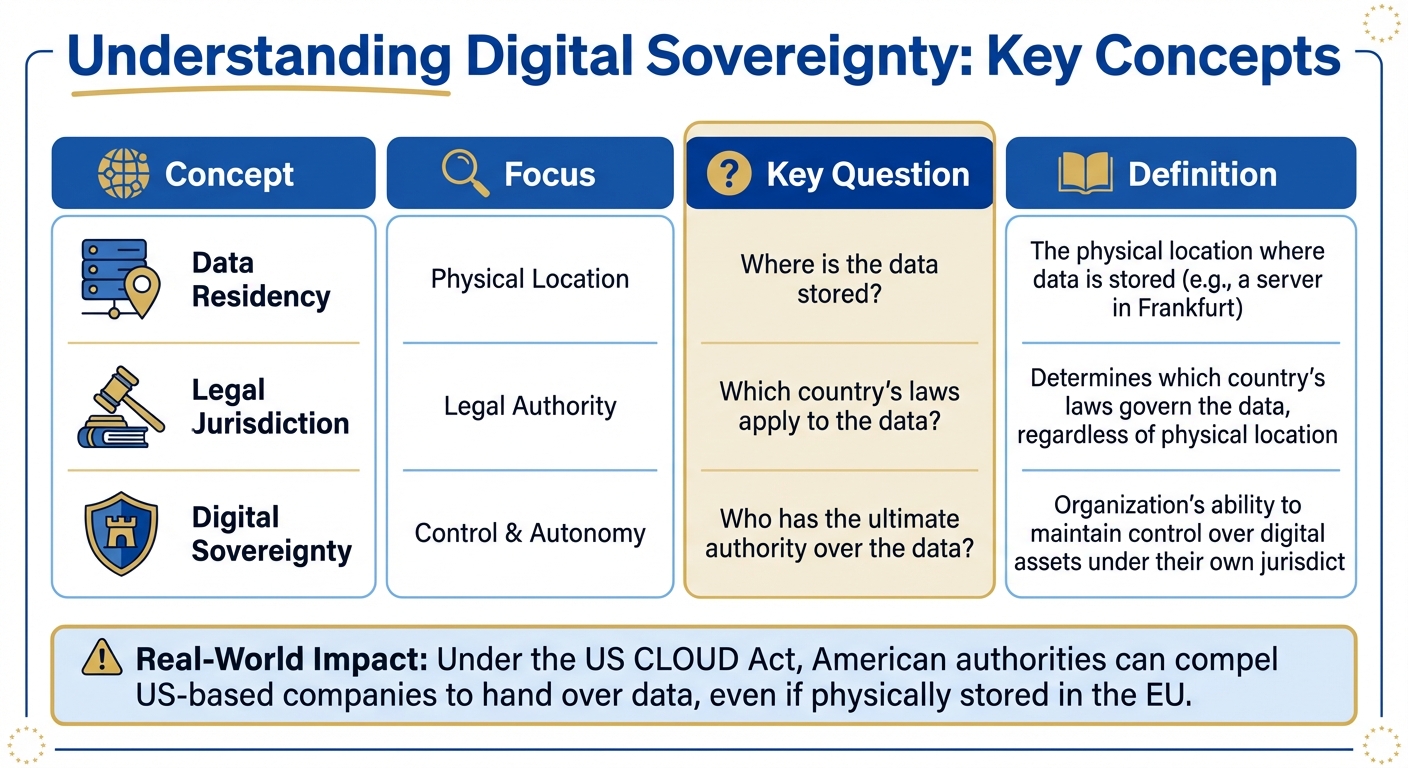
Data Residency vs Legal Jurisdiction vs Digital Sovereignty Comparison
Digital sovereignty refers to an organization’s ability to maintain control over its digital assets – like data, infrastructure, and software – ensuring these assets are governed by the laws of its own jurisdiction rather than those of foreign entities [2]. In the context of cloud computing, it’s not just about knowing where your servers are physically located. It’s about understanding who has the ultimate authority to access, manage, or demand disclosure of your data.
Digital sovereignty breaks down into three key dimensions: jurisdictional control (which country’s laws govern your data), portability and exit rights (the ability to move data without major disruptions), and operational independence (ensuring resilience against geopolitical risks) [2]. Let’s explore how these ideas take shape in cloud computing.
Core Components in Cloud Computing
Modern sovereign clouds are designed with a “sovereign-by-design” approach. This means they incorporate physical, logical, and cryptographic separation from global public cloud systems, ensuring data residency is built directly into the architecture [6]. For instance, Oracle’s EU Sovereign Cloud restricts its support and operations exclusively to EU residents employed by EU-based legal entities [6].
To ensure compliance, organizations need to scrutinize their cloud infrastructure. It’s not enough to know where your data is stored – you must also understand the legal jurisdiction governing your provider [5]. For example, even if a US-based cloud provider operates a datacenter in Frankfurt, the data stored there may still fall under US legal authority. This distinction is crucial for achieving true digital sovereignty, as it goes beyond the physical location of data to address who controls it.
Data Residency vs. Legal Jurisdiction
A critical distinction in digital sovereignty lies between data residency and legal jurisdiction. While data residency refers to the physical location where data is stored – such as a server in Frankfurt – legal jurisdiction determines which country’s laws govern that data [7]. These two concepts don’t always align.
Concept
Focus
Key Question
Data Residency
Physical Location
Where is the data stored?
Legal Jurisdiction
Legal Authority
Which country’s laws apply to the data?
Digital Sovereignty
Control & Autonomy
Who has the ultimate authority over the data?
For example, under the US CLOUD Act, American authorities can compel US-based companies to hand over data, even if that data is physically stored in the EU [2]. This creates a situation where your data might physically reside in Europe but can still be accessed by a warrant issued in the United States.
Understanding these principles is essential when evaluating cloud providers. They highlight why governance tied to EU-based laws is so critical in ensuring digital sovereignty, a topic that will be explored further in the sections ahead.
Why European Businesses Need Digital Sovereignty
Digital sovereignty has become a pressing priority for European organizations, driven by the challenges of extraterritorial laws, strict data protection regulations, and the risks tied to foreign-controlled service providers. Let’s explore the legal, regulatory, and operational factors fueling this shift.
Extraterritorial Laws and Geopolitical Risks
The US CLOUD Act poses a direct challenge to European data protection principles. This law allows American authorities to demand data from US-based cloud providers, even when that data is physically stored in the European Union [2][5]. For instance, data housed in a Frankfurt data center could still be accessed under a US-issued warrant if the provider falls under US jurisdiction.
This mismatch between where data resides and who controls it legally is a growing concern. A 2024 study revealed that 43% of multinational corporations face conflicting legal obligations when operating across multiple jurisdictions [1]. European businesses are particularly caught in this dilemma, as they must adhere to GDPR’s rigorous data protection standards while their service providers may be compelled to act against those same principles under foreign laws.
Geopolitical instability further complicates the situation. The Cloud Infrastructure Services Providers in Europe (CISPE) has advocated for “Trump-Proof” cloud solutions – platforms designed to be “immune from disruption, access, and potential removal by foreign actors”[4]. These geopolitical and legal risks highlight why European organizations must prioritize control over their data, not just its physical location.
The 2020 Schrems II ruling dramatically reshaped how European businesses assess cloud providers. The Court of Justice of the European Union invalidated the EU-US Privacy Shield, citing US surveillance laws as incompatible with EU fundamental rights[1][6]. This decision has made data transfers to US-based providers fraught with legal uncertainty.
Compliance with GDPR is no small feat, especially for mid-sized firms, which spend an average of €1.3 million annually on related efforts. Adding to this, the EU Data Act – set to take effect in September 2025 – will further simplify switching providers by banning punitive egress fees starting in January 2027[1][2]. GDPR’s reach extends to all personal data of EU residents, regardless of where it is processed, requiring even non-EU entities to appoint representatives within the bloc [1]. These stringent requirements elevate digital sovereignty from a compliance issue to a strategic necessity.
Dependency Risks with Non-European Cloud Providers
Exclusive reliance on non-European cloud providers introduces operational risks that go beyond legal compliance. For example, international sanctions or significant cyber incidents affecting foreign providers could disrupt business operations [2].
“Relying on foreign cloud services introduces risks that no business can control, and that few can absorb.” – Gcore [5]
The EU’s “Path to the Digital Decade” initiative aims for 75% of EU enterprises to use cloud or AI services by 2030[1]. However, this growth must align with sovereignty concerns. Currently, 80% of European companies using cloud infrastructure are either considering or actively transitioning to sovereign cloud solutions[5]. This trend underscores a growing recognition that jurisdictional control over digital assets is no longer optional – it’s a core element of risk management in an uncertain geopolitical landscape.
Problems with Global Hyperscale Cloud Providers
Many European businesses believe that selecting a European datacenter from a major global cloud provider resolves their concerns about digital sovereignty. However, the physical location of data does not automatically ensure legal protection. While European datacenters address data residency, they fall short of guaranteeing jurisdictional control.
European Hosting Doesn’t Mean European Control
Storing data in a datacenter located in cities like Frankfurt or Amsterdam might seem like a safe choice, but it offers limited protection if the cloud provider is based in the United States. Under the US CLOUD Act, American authorities can demand access to data from US-based companies, regardless of where the data is physically stored [2]. This means even data housed in Europe can be subject to foreign government scrutiny.
This legal conflict poses a significant challenge for European businesses. They need to comply with GDPR, yet their cloud providers might be forced to act against these regulations under foreign surveillance laws. Major US cloud providers have openly acknowledged that they would hand over data pertaining to European citizens to US authorities if legally required, even though their services are often marketed as “sovereign cloud” solutions [13]. In this scenario, the legal jurisdiction of the parent company takes precedence over the physical location of the datacenter.
Technical measures like encryption offer limited help here. If the provider controls the encryption keys or has administrative access, legal mandates can still override these safeguards [12]. As French MP Philippe Latombe pointed out:
“AWS cloud cannot be sovereign because it is subject to the US FISA and Cloud Act” [12]
This mismatch between where data is stored and who controls it creates significant hurdles for businesses relying on global providers.
Lack of Transparency and EU-Specific Compliance
Beyond jurisdictional issues, global hyperscale cloud providers often lack transparency, adding another layer of complexity. These providers typically operate under a “shared responsibility” model. While this approach sounds reasonable on paper, it often leaves European businesses vulnerable. Providers manage the infrastructure, but customers remain accountable for GDPR compliance and fines – despite having little control over the systems, supply chains, or how the provider handles foreign legal demands [11].
This creates a compliance gap. Many standard cloud services were not designed with the specific needs of EU regulations in mind, forcing businesses to take on additional compliance measures. The lack of clarity about who can access data, which foreign laws apply, and how providers might respond to conflicting legal demands makes it nearly impossible for businesses to conduct thorough risk assessments.
Adding to the problem is the dominance of a few major players – Amazon, Microsoft, and Google – who collectively hold nearly 70% of the European cloud market. This concentration of power often leads to vendor lock-in, making it difficult for businesses to negotiate terms or switch providers when sovereignty concerns arise. Proprietary software and long-term contracts further complicate efforts to align services with EU regulatory requirements [9][10].
These challenges highlight the importance of looking beyond physical data hosting locations when assessing cloud providers. The next section will explore how to evaluate sovereign cloud solutions effectively.
sbb-itb-bea6502
How to Evaluate Cloud Providers for Digital Sovereignty
Choosing the right cloud provider for digital sovereignty involves more than just selecting one with a European datacenter. While the physical location of servers is important, it’s only part of the equation. European organizations must take a broader approach, evaluating providers across several critical factors to ensure their data remains under European legal jurisdiction.
What to Look for in a Sovereign Cloud Solution
When assessing a cloud provider, focus on six essential areas. Jurisdictional control is paramount – ensure the provider is governed exclusively by EU laws and isn’t subject to extraterritorial regulations like the US CLOUD Act [4][2]. Next, examine portability and exit rights, as the EU Data Act will prohibit punitive egress fees starting in January 2027 [2]. For encryption and key management, prioritize solutions that allow for HYOK (Hold Your Own Key) management [2][14].
Take a close look at the provider’s operational architecture. Confirm that EU-resident personnel manage operations and that EU-incorporated entities own the hardware and leases. Be cautious of entities that might merely act as fronts for non-European companies [14]. Assess regulatory alignment by checking for adherence to frameworks such as Gaia-X, the EU Cloud Certification Scheme (EUCS), or France’s SecNumCloud [4][2]. Lastly, evaluate resilience testing – this includes migration trials and failover capabilities to ensure uninterrupted operations in the event of geopolitical disruptions [2].
Once these broader criteria are addressed, consider how the provider’s datacenter locations contribute to maintaining legal control.
EU-Only Datacenter Locations
Cloud providers with datacenters exclusively within EU borders offer stronger digital sovereignty assurances compared to those with global infrastructures. For instance, Oracle’s EU Sovereign Cloud operates isolated regions in Frankfurt and Madrid, accessible only by EU-resident personnel [14]. This separation is crucial because it prevents foreign governments from exploiting the provider’s global network to access data.
It’s also important to distinguish between “sovereign regions” and standard “European regions.” A sovereign region operates independently from a global network, while a European region may simply be part of a larger, worldwide system. With European public cloud spending growing from $110 billion in 2022 to approximately $150 billion by the end of 2023, businesses are increasingly recognizing the importance of complete architectural separation. Such separation ensures that data governance remains entirely under EU jurisdiction, a fundamental aspect of digital sovereignty [8].
Providers Subject Only to EU Law
Beyond datacenter location, jurisdictional control is critical. Providers must operate solely under EU legal frameworks to eliminate the risk of “conflict of laws.” If a provider’s parent company is based outside the EU, foreign courts could potentially demand access to data, regardless of its physical location.
This is why legal jurisdiction takes precedence over server location. Providers governed exclusively by EU law cannot be compelled to comply with foreign data requests, even if those requests are backed by extraterritorial legislation. For businesses handling sensitive information, this legal protection is the cornerstone of digital sovereignty. The risks of neglecting this principle are evident – take the €1.2 billion ($1.3 billion) fine imposed on Meta in 2023 by the Irish data regulator for GDPR violations involving EU-US data transfers [3][8].
Benefits of European Cloud Providers
European cloud providers address the growing need for digital sovereignty by ensuring their operations are governed solely by EU law. This approach guarantees long-term control over data, even in uncertain geopolitical climates. When providers are fully EU-based – owning their hardware, data centers, and leases within the EU – jurisdictional conflicts are significantly reduced. Unlike providers headquartered outside the EU, European providers are not subject to foreign laws, such as those in the United States, which could otherwise compel data access. This eliminates the legal ambiguities often associated with non-EU providers [2][4].
Built-In Compliance with EU Regulations
Providers native to the EU are inherently aligned with key regulations like GDPR, Schrems II, NIS 2, and the Data Act. Instead of relying on policies to enforce compliance, their infrastructure and operations are designed to meet these standards from the ground up. For example, isolated infrastructure ensures data residency, minimizing the risks of misconfigurations [6]. Moreover, all operational and support functions are handled exclusively by EU-based personnel [6].
This integrated approach to compliance reduces the need for additional legal reviews or transfer impact assessments. It also enhances operational stability. Upcoming initiatives, such as the 2025 Data Union Strategy and the Digital Omnibus, further simplify compliance by unifying EU data regulations. This makes it easier, especially for small and medium-sized enterprises (SMEs), to navigate regulatory requirements [15].
Protection from Foreign Data Access
One of the most compelling advantages of European cloud providers is their immunity to extraterritorial laws. For instance, US-headquartered providers remain subject to the CLOUD Act, which allows US authorities to demand access to data, regardless of where it is stored. European providers, operating exclusively under EU law, face no such obligations. As CISPE emphasized:
“Europe needs Trump-Proof cloud services and options to select 100% European cloud infrastructure and services, immune from disruption, access and potential removal by foreign actors.” [4]
This legal clarity ensures that European providers are governed by a single legal framework, offering businesses greater security and peace of mind. It’s a shift that many companies are embracing. By late 2025, over 80% of European firms using cloud services were exploring or transitioning to sovereign solutions [5]. As Hani Banayoti, Founder of CyberSolace, aptly put it:
“Sovereignty is not about where your data sleeps – it’s about who can wake it up.” [2]
European cloud providers ensure that only EU courts and regulators have jurisdiction over data, reinforcing digital sovereignty and providing a strategic edge for organizations that prioritize secure and compliant operations.
flexidesktop: EU-Hosted Cloud Desktops for Data Sovereignty
flexidesktop addresses the challenges posed by global hyperscale providers by offering a solution tailored specifically for European businesses. This service provides cloud-hosted Windows virtual desktops designed to meet the needs of organizations that prioritize control over data location and jurisdiction. Hosted entirely within EU data centers, flexidesktop ensures that all data – backups, snapshots, and operational logs – remains governed by EU laws throughout its lifecycle.
Complete EU Data Residency for Virtual Desktops
flexidesktop guarantees that its virtual desktops operate exclusively in data centers located within the European Union. These centers are owned and managed by EU-based entities, which also hold the infrastructure and data center leases. This setup eliminates the risk of exposure to extraterritorial laws, such as the US CLOUD Act [6][14]. Furthermore, all support and operational tasks are carried out by EU residents employed by these entities, ensuring that non-EU personnel cannot access sensitive data [6][14].
By maintaining jurisdiction solely within the EU, flexidesktop provides the legal clarity and data protection that European businesses increasingly require.
Security and Compliance Features
flexidesktop offers a robust security framework that includes daily encrypted backups, isolated private networks, and VPN access for secure cybersecurity operations to safeguard data and maintain tenant separation. The infrastructure is designed to be physically, logically, and cryptographically isolated from non-EU systems, creating a secure and sovereign cloud environment [6]. Businesses using flexidesktop retain full administrative control over their virtual desktops, allowing them to implement security policies that comply with GDPR, NIS 2, and the EU Data Act, which takes effect in September 2025 [1][2].
This solution is particularly relevant for organizations in regulated industries like healthcare, finance, or professional services, where handling sensitive data demands strict compliance. With flexidesktop, these businesses can achieve compliance without facing the legal uncertainties often associated with US-based providers. Its strong security and compliance measures make flexidesktop a dependable choice for organizations seeking to maintain digital sovereignty.
Conclusion
Digital sovereignty has evolved into a critical business necessity, shaped by extraterritorial laws, regulatory changes like the EU Data Act (coming into effect in September 2025), and ongoing geopolitical challenges. The location of your data and the control you have over it are no longer abstract concerns – they directly influence your operational stability and legal exposure. As Hani Banayoti of CyberSolace aptly explains:
“Sovereignty is not about where your data sleeps – it’s about who can wake it up” [2].
For organizations handling sensitive data under regulations like GDPR, NIS 2, or industry-specific rules, choosing an EU-based cloud provider eliminates the legal uncertainties often associated with global hyperscalers. It also fosters trust with customers and partners. By hosting your infrastructure entirely within the EU and ensuring it is operated by EU-based personnel under EU legal entities, you minimize foreign jurisdiction risks and simplify compliance. This isn’t just about avoiding penalties – it’s about earning the confidence of stakeholders who now see data sovereignty as non-negotiable.
The economic implications are just as pressing. Compliance and data localization represent significant costs, but even modest adoption of EU-standard procurement practices could inject billions into Europe’s cloud ecosystem. These numbers underline how sovereignty choices impact not just individual businesses but also the broader digital economy in Europe.
This growing financial and regulatory pressure highlights the need for solutions that combine adaptability with strong data control. European businesses no longer have to compromise between cloud flexibility and sovereignty. Tools like flexidesktop demonstrate that it’s possible to have both – a cloud-hosted virtual desktop solution offering complete EU data residency, advanced security measures, and the legal clarity of operating entirely under European law. For industries such as healthcare, finance, and professional services – where regulated data is the norm – this approach shifts sovereignty from a compliance burden to a strategic advantage.
For companies across Europe prioritizing operational stability and legal certainty, flexidesktop offers a cloud desktop solution hosted exclusively in the EU. Contact flexidesktop for a free demo and customized trial to meet your specific needs.
FAQs
What are the benefits of choosing an EU-based cloud provider for digital sovereignty?
Choosing a cloud provider based in the EU means your data falls under European laws, such as GDPR. These laws set clear rules for safeguarding personal data, reducing the risks tied to cross-border data transfers and helping your business stay compliant with EU regulations.
Another key benefit is protection from foreign extraterritorial laws like the U.S. CLOUD Act. Such laws could otherwise grant non-EU governments access to your data. By choosing an EU-hosted service, you gain a more secure and predictable legal framework for your operations.
Many European cloud providers also align with EU-backed initiatives like the CISPE Sovereign Cloud Principles. This alignment promotes transparency, offers compliance tools customized for European standards, and ensures independence from non-European hyperscalers. These features make EU-based providers an excellent choice for businesses managing sensitive or regulated data while prioritizing security and operational independence.
How does the U.S. CLOUD Act impact data stored in European datacenters?
The U.S. CLOUD Act grants U.S.-based cloud providers the authority to comply with legal requests from U.S. law enforcement, even if the data in question is stored in datacenters located outside the United States, including Europe. In practice, this means that data physically housed in Europe can still fall under U.S. jurisdiction if the cloud provider’s headquarters are in the United States.
For businesses operating in Europe, this raises concerns about data sovereignty and adherence to local regulations. The possibility of U.S. access to data stored in Europe may conflict with European legal frameworks. To address this, many companies opt for cloud providers that operate exclusively under EU laws, reducing exposure to such jurisdictional complexities.
What steps should businesses take to comply with the EU Data Act?
To align with the EU Data Act, businesses need to take actionable steps to manage their data and cloud service agreements effectively.
Start by conducting a thorough data inventory to pinpoint which data sets fall under the Act and where they are stored. This is crucial for meeting the Act’s data portability requirements, which allow customers to access and transfer their data without hassle. Additionally, ensure your cloud service contracts include clear exit clauses to avoid hefty fees when switching providers. These contracts should outline supported file formats, timelines, and the level of assistance available to make data migration as smooth as possible.
It’s also wise to select cloud providers that guarantee data residency within the EU and operate under EU laws, shielding your business from foreign regulations like the U.S. CLOUD Act. Regularly perform Data Protection Impact Assessments (DPIAs) to check compliance with portability and switching rights. Lastly, establish ongoing governance by auditing your providers, keeping an eye on changes to data processing terms, and updating your internal policies to stay current. These measures will help ensure compliance with the EU Data Act while maintaining control over your data.
Israel de la Torre is the founder of flexidesktop and has spent 15+ years working in cloud infrastructure and Windows virtualization. He helps businesses migrate from on-premises Windows setups to managed cloud desktops.
Compare remote-access apps and cloud desktops to choose the right RDP alternative—use remote tools for occasional access or cloud PCs for always-on team work.
To provide the best experiences, we use technologies like cookies to store and/or access device information. Consenting to these technologies will allow us to process data such as browsing behavior or unique IDs on this site. Not consenting or withdrawing consent, may adversely affect certain features and functions.
Functional
Always active
The technical storage or access is strictly necessary for the legitimate purpose of enabling the use of a specific service explicitly requested by the subscriber or user, or for the sole purpose of carrying out the transmission of a communication over an electronic communications network.
Preferences
The technical storage or access is necessary for the legitimate purpose of storing preferences that are not requested by the subscriber or user.
Statistics
The technical storage or access that is used exclusively for statistical purposes.The technical storage or access that is used exclusively for anonymous statistical purposes. Without a subpoena, voluntary compliance on the part of your Internet Service Provider, or additional records from a third party, information stored or retrieved for this purpose alone cannot usually be used to identify you.
Marketing
The technical storage or access is required to create user profiles to send advertising, or to track the user on a website or across several websites for similar marketing purposes.
To provide the best experiences, we use technologies like cookies to store and/or access device information. Consenting to these technologies will allow us to process data such as browsing behavior or unique IDs on this site. Not consenting or withdrawing consent, may adversely affect certain features and functions.
Functional
Always active
The technical storage or access is strictly necessary for the legitimate purpose of enabling the use of a specific service explicitly requested by the subscriber or user, or for the sole purpose of carrying out the transmission of a communication over an electronic communications network.
Preferences
The technical storage or access is necessary for the legitimate purpose of storing preferences that are not requested by the subscriber or user.
Statistics
The technical storage or access that is used exclusively for statistical purposes.The technical storage or access that is used exclusively for anonymous statistical purposes. Without a subpoena, voluntary compliance on the part of your Internet Service Provider, or additional records from a third party, information stored or retrieved for this purpose alone cannot usually be used to identify you.
Marketing
The technical storage or access is required to create user profiles to send advertising, or to track the user on a website or across several websites for similar marketing purposes.